Start with an ordinary evening
Imagine arriving in rain, placing a bag down, changing clothes and making a drink. This modest sequence tests a room more effectively than imagining the perfect sunrise. Is there a covered entrance? Can you close the curtains before switching on bright lights? Is the bathroom enclosed, and is there somewhere to put wet clothing? A compact cabin can handle these tasks beautifully, but not every striking layout does. Ask for a floor plan and a plain description of storage, circulation and bathroom arrangements. The useful details are usually less glamorous than the main photograph.
Sleep requires more than a view
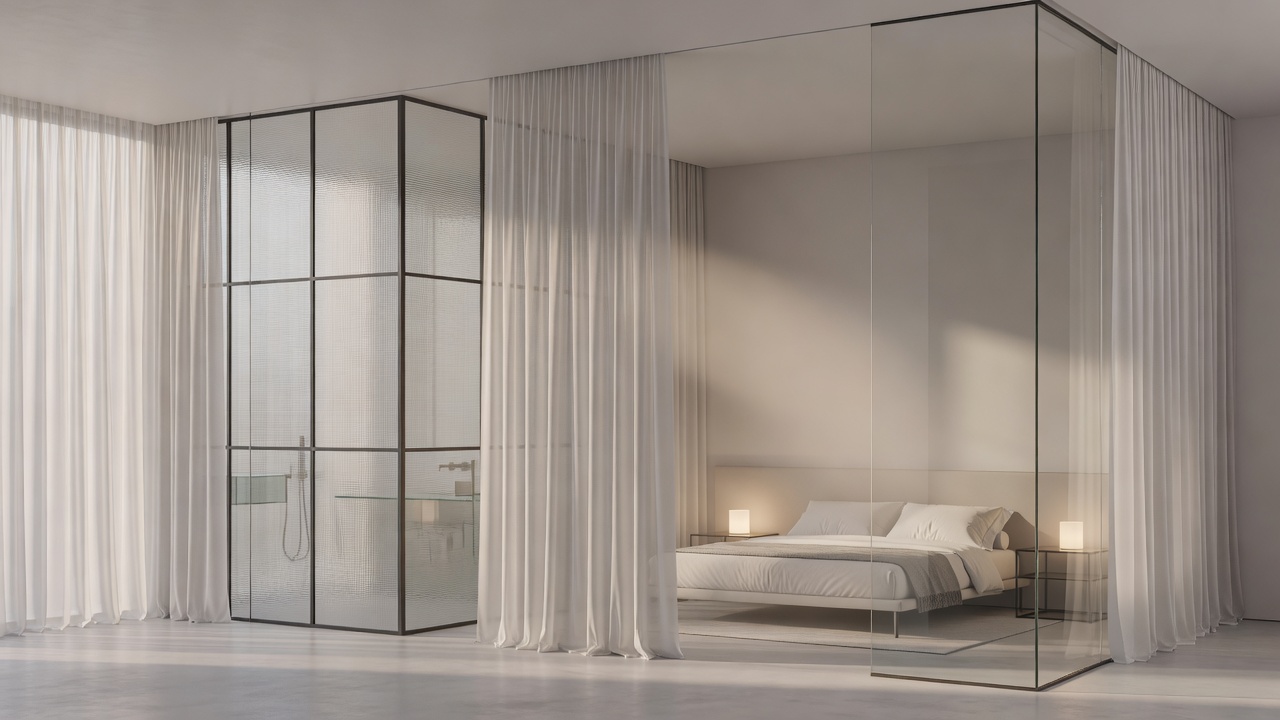
Blackout should be assessed across the whole room, including skylights, door panels and the edges of coverings. A curtain that darkens the lower wall may leave a bright roof directly above the bed. Noise also has several possible sources: ventilation, pumps, adjoining decks, service traffic and sound travelling across water. The World Health Organization's environmental noise guidance explains why noise matters to wellbeing, but it cannot predict conditions in a particular suite. Ask the operator about actual equipment and nearby activity. If you are a light sleeper, describe your concern specifically rather than asking whether the place is “quiet.”
Make bathroom privacy explicit
Open-plan bathrooms divide opinion, and the word “suite” does not resolve the question. Check for an opaque enclosure, a closing door and a screening arrangement that works both from outside and from the rest of the room. Couples do not necessarily have identical privacy preferences. Ask whether the toilet is separately enclosed, whether bathroom lights expose the bedroom through internal glass, and whether an extractor runs loudly at night. These are reasonable practical questions. Do not rely on a floor plan alone if the materials are unclear; transparent, translucent and opaque partitions behave differently.
Controls should belong to the guest
A comfortable room allows useful adjustments without requiring a call to reception. Find out whether guests can set the temperature, operate ventilation, dim lights and close all coverings independently. Ask what happens if an automated system fails or a remote control is missing. Touch panels can be neat but unfamiliar, while a clear manual switch may be easier to use in darkness. If heating or cooling is centrally limited, request the operating range and hours. A statement that the building is environmentally designed does not answer how an individual guest manages an unexpectedly warm or cold night.
Access is a route, not a label
“Accessible” can conceal a range of assumptions unless the operator provides dimensions and a description of the entire journey. Consider parking, paths, gradients, thresholds, door widths and bathroom layout, along with any luggage transfer. A lakeside deck may introduce a surface or level change that is not obvious indoors. If you have mobility, sensory or other access requirements, describe what works for you and request room-specific information. Do not accept a view of the entrance as a complete access assessment. Emergency communication and the ability to reach staff also matter at a remote property.
Read environmental claims narrowly
Transparent architecture is not inherently low impact, and a small floor area does not by itself establish modest energy use. Look for clear information about heating, water, wastewater and how the site is managed. The EU Ecolabel has criteria for tourist accommodation; it is meaningful to check a claimed certification rather than assume every phrase such as “eco retreat” refers to an equivalent standard. Certification still does not answer all comfort or privacy questions. Ask separately about cleaning products if relevant, drinking water arrangements and any restrictions on showers or heating that could affect your stay.
Keep commercial details separate from the image
Check the exact room category, occupancy, included meals, transfers, deposit and cancellation terms with the operator before paying. Remote sites may have limited alternatives if weather disrupts travel, so clarify late arrival and interruption arrangements. Never infer a private sauna, hot tub or exclusive jetty from an image that might show shared facilities. Save the description and written answers that inform your decision. Mangovexum does not take reservations or quote live availability. Our purpose is to help you make a small, precise list of questions so that the room you book matches the privacy and comfort you expect.
Sources and further reading
- World Health Organization, Europe — environmental noise and health guidance.
- European Commission: EU Ecolabel — the scheme and product-group criteria, including tourist accommodation.
- Your Europe — official consumer and travel-rights context; the applicable rules depend on the booking.
These sources support general questions. They do not certify the facilities or accessibility of an individual room.
Keep your questions together
Try the local message-drafting tool. It creates plain text and sends nothing.